What companies say AI returns: twelve disclosures measured against revenue
Twelve companies that put a dollar figure on their AI gains in 2025 and 2026, converted to an annual amount and compared with revenue. The median realised gain is 0.9% of revenue. Two of the twelve also stated what they spend on AI, which is what a return calculation needs.
More companies now put a number on what AI has done for them. In the second quarter of 2026, 25% of S&P 500 companies cited at least one quantifiable AI benefit on earnings calls or at conferences, up from 10% in the fourth quarter of 2024 (Morgan Stanley). Below are the dollar figures that twelve large companies stated in 2025 and 2026, each converted to an annual amount and compared with the company's revenue.
Summary:
- Twelve companies stated a dollar figure for their AI gains: ten realised and two targets. The realised figures range from about US$26 million a year (Commonwealth Bank) to US$4.5 billion (IBM).
- The median realised figure is 0.87% of the company's annual revenue. Five of the ten are below 1%. Three are above 3%: IBM (6.7%), DBS (4.5%) and ServiceNow (3.8%).
- Two of the twelve, JPMorgan and Commonwealth Bank, also stated what they spend on AI. Only those two allow a return on investment to be worked out. JPMorgan put the benefit at about the same as the spend; Commonwealth Bank said it spent more than it gained in FY2025 and FY2026.
- One company, DBS, described how its figure was measured (AI-enabled customers compared with control groups).
- Seven of the twelve figures are cost savings only; the other five combine cost savings, revenue and other measures. Morgan Stanley analysts expect 89% of AI benefits at adopting companies over the next one to two years to come from cost efficiency.
- The ten realised figures add up to about US$9 billion a year, of which IBM and JPMorgan account for 72%.
Terms
- Return on investment (ROI): the gain from an investment less its cost, divided by its cost. It needs both the gain and the cost.
- Realised: a gain the company says has already been achieved.
- Target: a gain the company expects to achieve.
- Run-rate: the annual amount implied by the rate at the end of a period. A US$100 million run-rate at December means savings in December at a pace of US$100 million a year.
- Certified filing: an annual or quarterly report filed with the SEC (10-K, 10-Q, 20-F, 40-F) that the chief executive and chief financial officer certify under the Sarbanes-Oxley Act. Earnings calls and press releases are not certified.
How the figures were collected
- Selection. Companies that stated a dollar figure for gains attributed to AI between July 2025 and November 2026, found through two published compilations (Hudson Labs and Alan Paris) and news reports of earnings calls. Companies that gave only percentages or qualitative statements are listed separately.
- One figure per company. The most recent figure, as stated. Where only part of a program is attributed to AI, only that part is used (PayPal, Commonwealth Bank).
- Annual amount. Run-rates and annual figures are used as stated. Santander's nine-month figure is multiplied by 4/3.
- Revenue. Latest fiscal-year revenue from stockanalysis.com, in the company's reporting currency. The ratio is computed in that currency.
- US dollars. Converted at 2025 average exchange rates from FRED, for the dollar chart only.
Result 1: more companies cite a measurable benefit
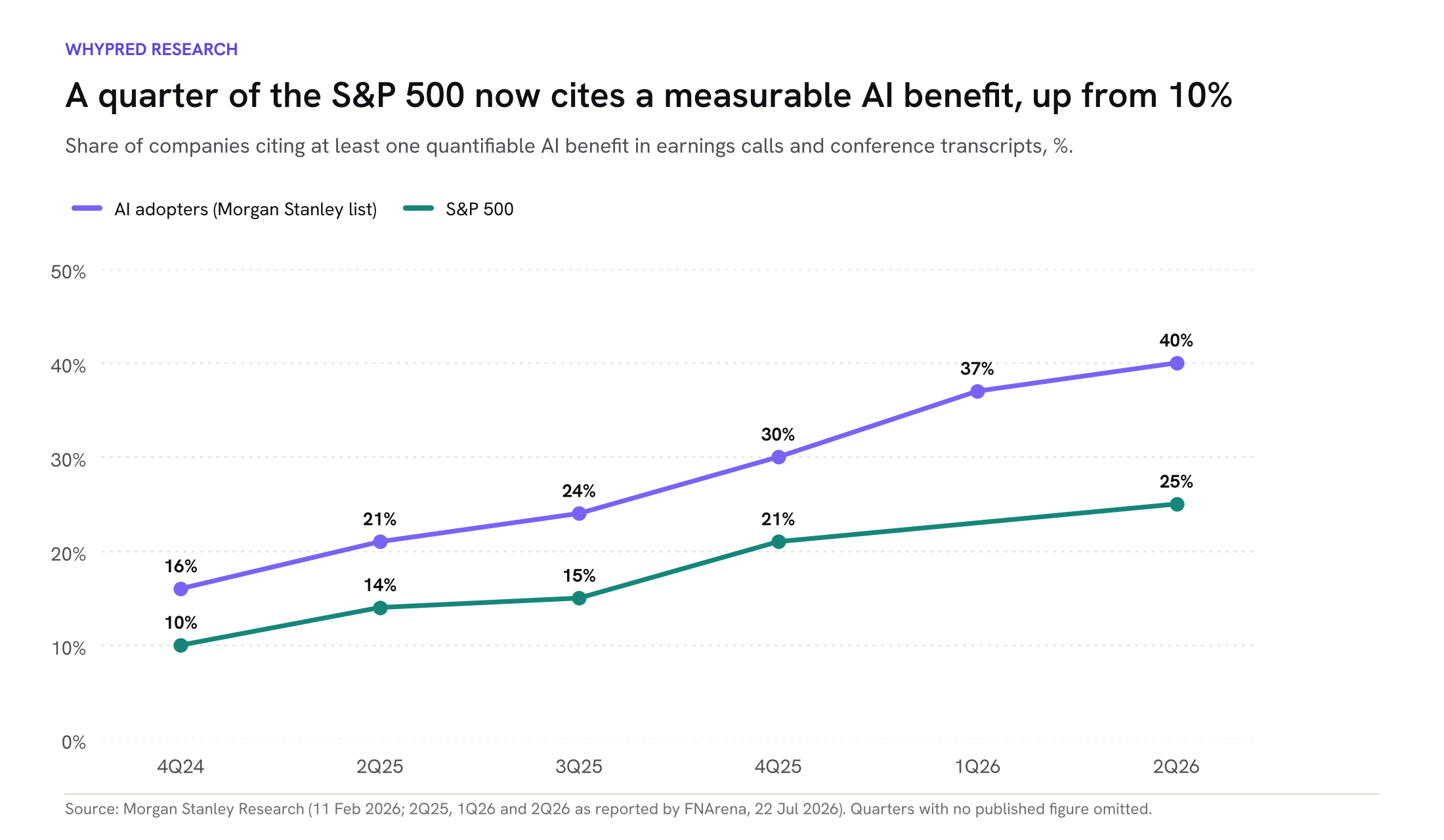
Morgan Stanley classifies earnings call and conference transcripts (more than 10,000 in its February 2026 update) by whether management cites at least one quantifiable AI benefit. Among companies its analysts identify as AI adopters, the share rose from 16% in the fourth quarter of 2024 to 40% in the second quarter of 2026. For the whole S&P 500 it rose from 10% to 25%. By sector in the second quarter of 2026, the share was 51% in technology, 44% in communication services and 37% in financials.
A quantifiable benefit in this count can be any number: a percentage, a time saving or a dollar amount. It does not mean the company stated a return.
Result 2: the twelve dollar figures
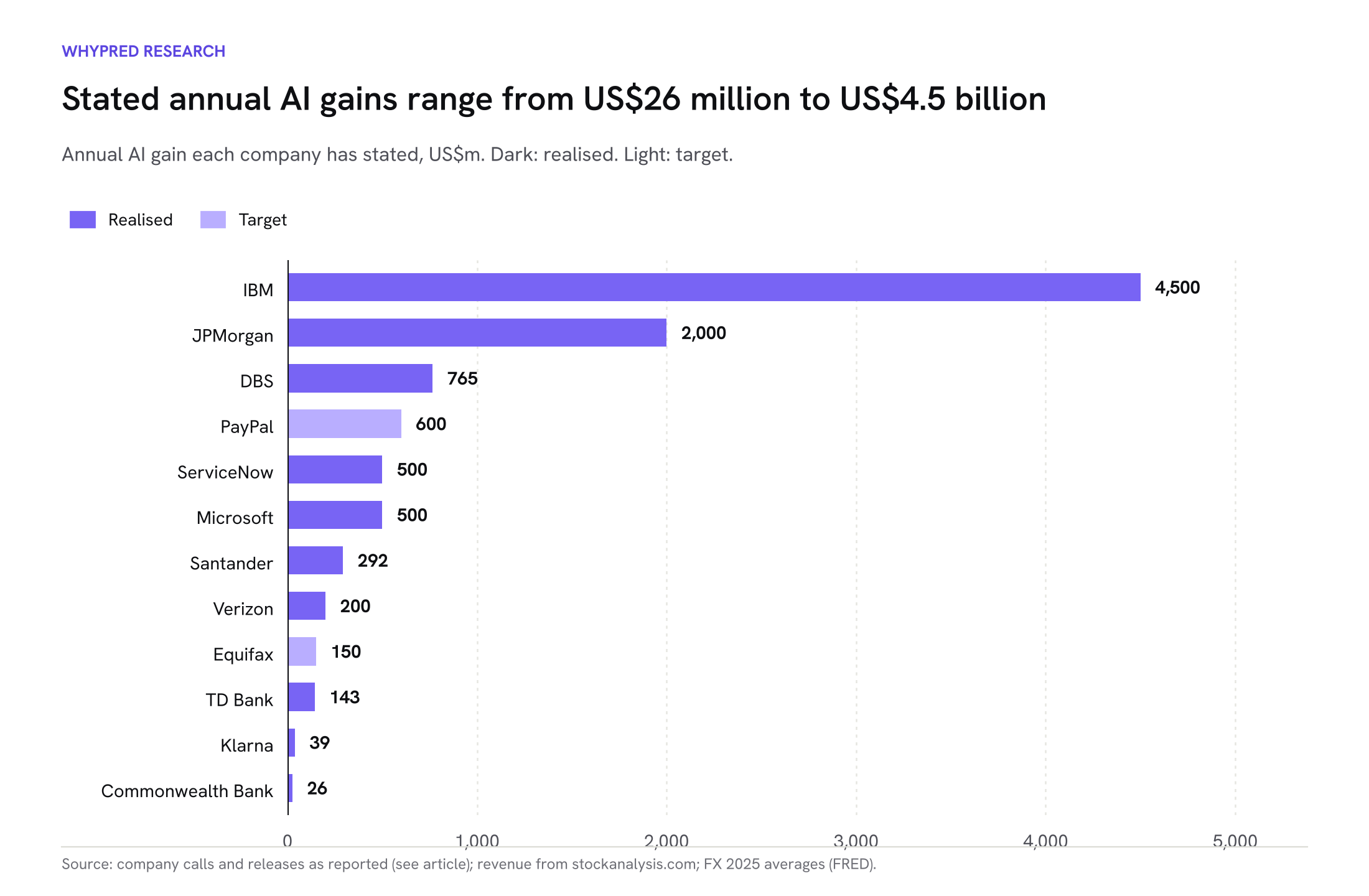
| Company | Figure as stated | Status | Annual, US$m | % of revenue | AI spend stated |
|---|---|---|---|---|---|
| IBM | US$4.5bn annual run-rate productivity savings exiting 2025 | Realised | 4,500 | 6.66% | No |
| DBS | S$1bn economic value from AI and data analytics in 2025 | Realised | 765 | 4.52% | No |
| ServiceNow | US$500m annualised value from internal AI in 2025 | Realised | 500 | 3.77% | No |
| Equifax | US$150m run-rate savings, 2026 to 2028 | Target | 150 | 2.47% | No |
| PayPal | AI "close to 40%" of a US$1.5bn run-rate savings plan | Target | 600 | 1.81% | No |
| Klarna | US$39m saved by its AI assistant in 2024 | Realised | 39 | 1.39% | No |
| JPMorgan | About US$2bn of benefit a year | Realised | 2,000 | 1.19% | Yes, about US$2bn |
| Santander | €194m business value in nine months of 2026 | Realised | 292 | 0.55% | No |
| TD Bank | C$195m in three quarters of FY2026; C$200m target "essentially hit" | Realised | 143 | 0.32% | No |
| Microsoft | US$500m saved in call centres | Realised | 500 | 0.18% | No |
| Verizon | Over US$200m of energy savings in its network | Realised | 200 | 0.14% | No |
| Commonwealth Bank | About 10% of A$400m cost savings over 12 months | Realised | 26 | 0.14% | Yes, more than the benefit |
The figures measure different things. IBM's US$4.5 billion is the run-rate of its whole productivity program, which covers more than AI. ServiceNow's US$500 million is "value", of which US$100 million was operating expense savings in 2025; it expects more than US$200 million of savings in 2026. Santander's figure combines extra revenue, lower costs and lower credit losses with no breakdown. Microsoft's figure was reported from an internal meeting in July 2025, with no period stated.
Result 3: the figures as a share of revenue
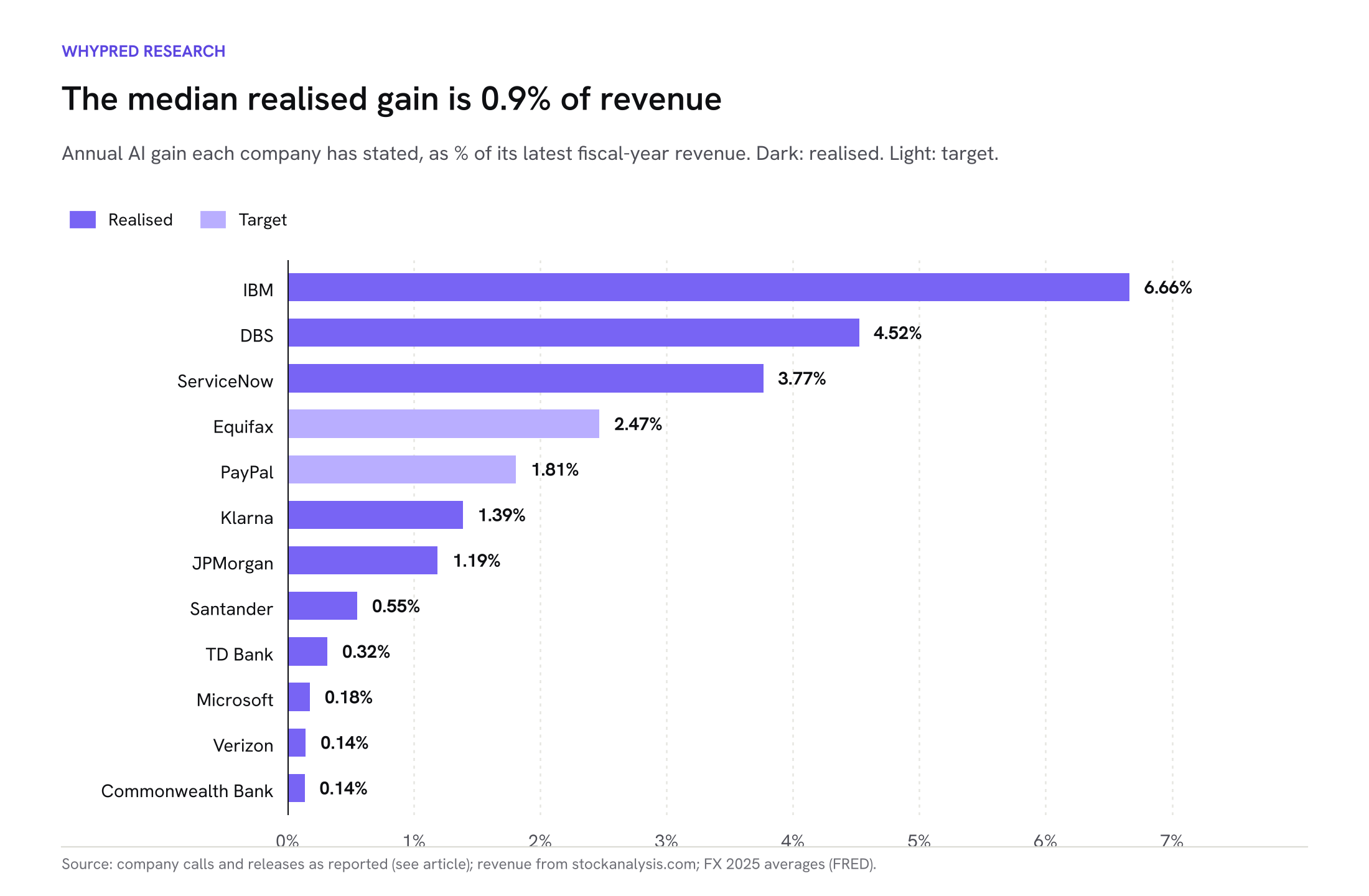
The median realised figure is 0.87% of revenue. The three largest shares belong to companies that are themselves suppliers of AI or software (IBM, ServiceNow) or that also reported an AI value figure for the previous year (DBS reported S$750 million for 2024). If ServiceNow's figure is limited to its 2025 operating expense savings, it is 0.75% of revenue.
The four banks other than DBS (JPMorgan, Santander, TD and Commonwealth Bank) are between 0.14% and 1.19% of revenue. TD's medium-term goal is C$1 billion a year, half from lower costs and half from higher revenue, which would be about 1.6% of its FY2025 revenue.
Result 4: what a return calculation needs
A return needs the cost as well as the gain. Two companies stated both.
- JPMorgan: Jamie Dimon told Bloomberg TV in October 2025: "for $2 billion of expense, we have about $2 billion of benefit." On those figures the annual benefit is about equal to the annual spend.
- Commonwealth Bank: CFO Alan Docherty said at the FY2026 results in August 2026 that the bank was "investing a little more than the benefits that we are realising through 2025 and 2026". He expects gross benefits to exceed investment in FY2027. He attributed "maybe around 10%" of A$400 million in cost savings over the year to AI.
The other ten gave a gain without the spend behind it. Their figures show the size of the gain, not the return.
Where the figures appear also matters. Alan Paris checked eleven companies that made public AI return claims against their SEC filings from January 2024 to October 2026. Three (PayPal, IBM and Klarna) put an AI-linked dollar figure in a certified filing, and each bundled AI with a reorganisation, a wider productivity program or a headcount reduction. The rest appeared only in calls, interviews and presentations.
Other measures companies report
Several companies report AI results without a dollar figure:
- Bank of America: fraud losses down 55% after moving to AI fraud models, and a 20% productivity gain among 18,000 developers using coding agents (investor day, November 2025).
- Verizon: expects AI to cut vendor support costs by more than 70%.
- Expedia: "hundreds of millions" in realised marketing value.
- Sony Interactive Entertainment: more than US$700 million of incremental revenue over three years from AI-based transaction routing.
Survey evidence
A survey of nearly 9,000 chief financial officers, chief executives and senior executives in seven countries, including Australia (NBER Working Paper 34836), found that 78% of firms use AI. Executives reported that AI raised labour productivity growth by 0.2% a year over the past three years, and expect 0.6% a year over the next three.
Scale against AI spending
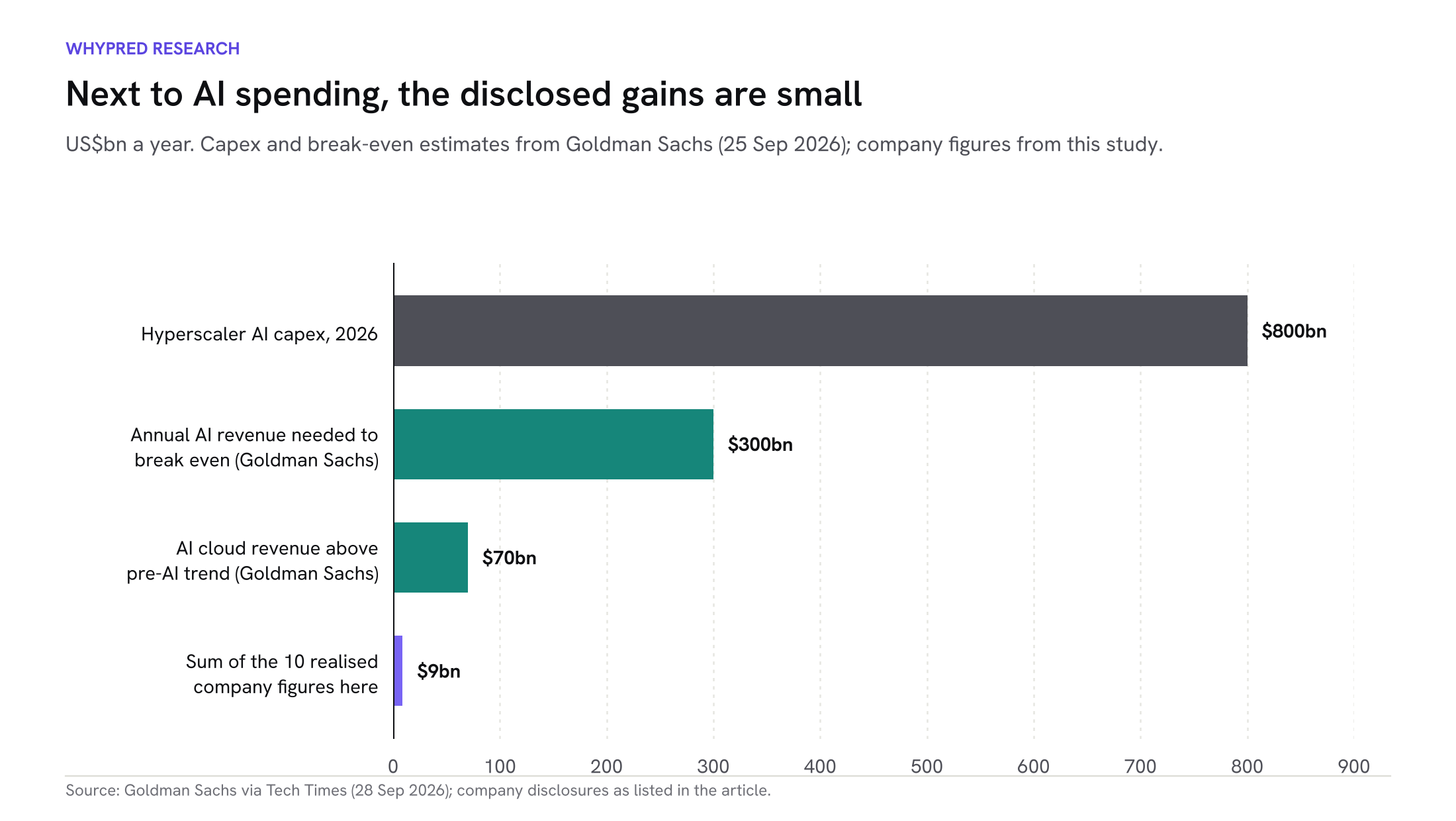
Goldman Sachs estimates that the five largest US hyperscalers will spend about US$800 billion on AI infrastructure in 2026. It estimates that about US$300 billion a year of AI revenue is needed to cover the full run-rate cost of that build. It estimates AI cloud revenue at about US$70 billion above its pre-AI trend. The ten realised company figures in this study add up to about US$9 billion a year. The two numbers measure different things: Goldman's is revenue to AI suppliers, the company figures are gains to AI users. The comparison shows the size of the disclosed gains, not whether the spending will be recovered.
Questions to ask about an AI return claim
- Is the figure realised, a run-rate or a target?
- Is it cost savings, revenue, or "value" that combines several things?
- What did the company spend on AI to get it?
- How was it measured: a control group, a before-and-after comparison, or an estimate of hours saved?
- Does it appear in a certified filing?
- Is AI bundled with other programs, such as restructuring or headcount cuts?
Limitations
- Selection. The twelve are companies that chose to state a dollar figure. Companies with no gain, or a gain they could not measure, are not in the list, so the list is likely to overstate typical gains.
- Different definitions. Value, savings and run-rate are not the same measure. Figures are compared with revenue as stated, without adjustment.
- Not audited. None of the figures is audited. Santander describes its figure as an alternative performance measure.
- Approximations. Santander is annualised from nine months; Commonwealth Bank uses "maybe around 10%" of A$400 million; PayPal uses "close to 40%" of its plan. Microsoft's and Verizon's figures have no stated period and are treated as annual.
- Revenue. Revenue is as shown on stockanalysis.com for the latest fiscal year. Bank revenue definitions differ between sources.
- Timing. Figures were stated between July 2025 and November 2026 and are compared with each company's latest fiscal-year revenue.
Sources
- Morgan Stanley Research, "AI rate of change", 11 Feb 2026
- FNArena, "AI's show me the money moment", 22 Jul 2026 (citing Morgan Stanley)
- Alan Paris, "AI ROI is a story executives tell, but not one they certify"
- Hudson Labs, "Quantified returns from AI adoption"
- SiliconANGLE, IBM fourth-quarter 2025 results, 28 Jan 2026
- Finextra, "JPMorgan spends $2bn a year on AI, saves same amount: Dimon"
- Fintech News Singapore, DBS AI value, 10 Feb 2026
- Rajesh Beri, "ServiceNow $500M AI value", 6 May 2026
- MarketBeat, PayPal at the Bernstein conference, 2 Jun 2026
- PYMNTS, "Early AI gains prompt Equifax to double savings forecast to $150 million", 21 Jul 2026
- BornCity, Santander AI value, 1 Nov 2026
- PYMNTS, "TD Bank unlocks $141 million in AI value months ahead of schedule", 27 Aug 2026
- TechRadar, "Microsoft says AI saved it $500 million", 10 Jul 2025
- RCR Wireless, Verizon first-quarter 2026, 28 Apr 2026
- Commonwealth Bank, 2026 full year results transcript
- American Banker, "Bank of America, JPMorganChase execs report returns on AI", Nov 2025
- Yotzov, Barrero, Bloom et al., "Firm Data on AI", NBER Working Paper 34836
- Tech Times, "Goldman Sachs quantifies AI's $230B annual gap", 28 Sep 2026
- stockanalysis.com, company income statements
- FRED, 2025 average exchange rates (DEXSIUS, DEXUSAL, DEXCAUS, DEXUSEU)